Looking Back: Textiles Recycling Expo Europe 2026
The Textiles Recycling Expo Europe, held alongside the Future Fabrics Expo in Brussels on the 24th & 25th of June 2026 brought together innovators, manufacturers, recyclers, brands and procurement professionals to explore the future of circular textiles. As Europe’s leading exhibition dedicated to textile recycling and circularity, the event provided a valuable opportunity to examine the latest technologies, legislation and practical circular solutions shaping the textiles industry.
Three topics stood out as particularly thought-provoking:
- Advancing the Future of Stretch, biobased and recycled elastane. Industry Roundtable 24/06/2026
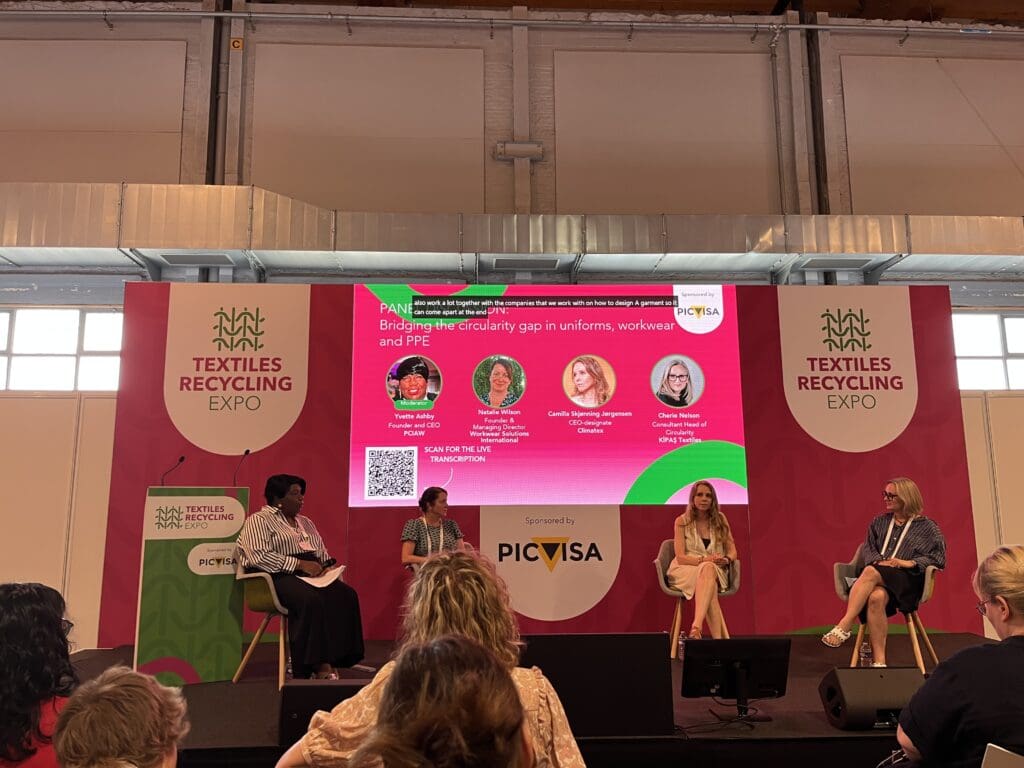
- Bridging the Circularity Gap in Uniforms, Workwear and PPE. Panel Discussion 25/06/2026
- The True Cost of Textiles: Waste, Responsibility and Europe’s Future. Panel Discussion 24/06/2026
The Future of Elastane
Conventional elastane can be a major disruptor to both mechanical and chemical recycling, presenting significant challenges for fibre recovery, material separation and the overall recycling process.
Compatibility with Recycling. Maximilian Koehnlein (Senior Specialist, Apparel Material Innovation).
The aim is to develop materials that are compatible with chemical recycling – allowing the effective valorisation of monomers without disrupting the process itself. Alongside recyclability, there is also an opportunity to address the carbon footprint of conventional plastics and explore more benign alternatives in the production of elastane.
Reduce and rethink. Lewis Shuler (VP of Advanced Concepts, Alpine).
The solution isn’t necessarily to eliminate elastane, but to reduce and rethink its use. Elastane has become a default component in many textiles, rather than a considered design choice. There is an opportunity to use it with greater intent – for example, only where stretch, recovery or shape retention is genuinely required. Design-led approaches can also reduce the need for elastane, through innovations such as textured or mechanical-stretch yarns, as well as garment construction and pattern design that can build stretch into the product itself.
Innovation without compromise. Julien Born (Board Member and Managing Director, TIRA Fibers).
Material innovation to reduce or replace elastane is a systemic challenge that requires an ecosystem of partners – from manufacturers and recyclers to industry stakeholders and consumers. Crucially, the value proposition must be attractive: new fabric innovations need to deliver the same levels of performance, comfort, fit and freedom of movement that consumers have come to expect from elastane. Elastane is highly valued because it enhances the everyday experience of clothing, so the goal shouldn’t be to ask consumers to compromise or change their behaviour. Instead, innovation needs to provide a better, more circular solution without taking away the benefits consumers value.
Ultimately, the future of elastane lies not necessarily in eliminating it, but in using it more intentionally and developing viable alternatives that can deliver the performance, comfort and freedom of movement consumers expect.
Bridging the Circularity Gap in Uniforms, Workwear & PPE
The professional clothing industry is often overlooked in conversations about textiles, particularly when compared with fashion. It can sometimes feel like the “ugly sister” of the fashion industry, but it is a major player – and arguably one of the most important when we consider who is wearing these products and why.
Designing for disassembly. Camilla Skjønning Jørgensen (Climatex)
Fastenings such as zips and buttons, which are widely used in workwear, can create significant challenges at end of life. Shredding garments with fastenings attached can contaminate recovered fibres, while manually removing them is labour-intensive and adds cost. This highlights the need to design for disassembly from the beginning. One emerging solution is Stitchlock’s “lock and unlock” technology. The thread performs like a conventional sewing thread during garment construction and use but can be ‘unlocked’ through a dissolving process at end of life, allowing components to be separated without labour-intensive removal. The technology could go beyond simply removing fastenings: when used throughout a garment, entire panels could be separated, creating opportunities for reuse before recycling. The technology is currently being validated with workwear companies, where durability is non-negotiable. While innovations like this may have clear applications in fashion, the key question for professional clothing is whether they can deliver the same long-term performance and reliability expected from workwear.
Shifting perspectives. Natalie Wilson (Founder & MD, Workwear Solutions International).
One challenge is convincing clients that designing a fully circular uniform range is achievable, particularly when it can be perceived as too difficult or too expensive. Setting clear technical specifications from the outset – including a robust bill of materials and set of minimum performance criteria – can help embed sustainability and durability into the programme, rather than treating them as additional considerations. The cost argument also needs to shift towards long-term value. Designing uniforms to last as long as possible benefits the entire workforce, rather than catering to short-lived, trend-led preferences. Well-designed uniforms can create emotional durability: when wearers understand the thought and sustainability considerations behind their uniform, they can develop a greater sense of pride and ownership. This encourages them to care for their garments, helping extend their lifespan while reducing repairs, replacements and costs for the client.
Ultimately, the future of uniforms lies in designing for longevity, performance and circularity from the outset – finding innovative solutions that reduce environmental impact without compromising the people who rely on these garments every day.
The True Cost of Textile Waste
Europe generates approximately 12.6 million tons of textile waste annually, with only 25-30% having economic reuse potential. This leaves 70-75% as waste. Do brands produce too much – or do consumers buy too much? Where does the greatest structural failure currently lie? Adam Mansell (UK Fashion and Textile Association).
Economic viability. Lutz Walter (European Textile Technology Platform).
The technology to process textile waste and scale innovative solutions exists, but the economics often don’t. Repurposed materials need to be functional, fit for purpose and affordable, while processors operate on increasingly thin margins. The challenge is therefore less about whether we can innovate, and more about whether we can make those innovations economically viable at scale.
The lack of a coordinated value chain. Vincenzo Gente (European Commission).
EU measures such as the Waste Framework Directive, Extended Producer Responsibility, Eco-design for Sustainable Products Regulation and the upcoming Circular Economy Act need to work together, with policy addressing every stage of the value chain. The problem doesn’t start with waste management; it starts with how we design and produce products and prevent waste in the first place. Rather than viewing waste purely as a cost, we should see it as a strategic opportunity to create value – using tools such as eco-modulation to incentivise better design and circularity.
The lack of market demand and infrastructure for recycled materials. Diane Woods (Global Head of Business Development and Product, Reju)
Mandatory recycled-content requirements could help create the demand needed to compete with an established, subsidised virgin polyester industry, particularly in Asia. However, capacity remains a major challenge: even with significant growth in recycled polyester, supply is unlikely to meet projected demand by 2035. This requires structural investment at a national level, alongside commitment from textile users to create and sustain demand. Consumer behaviour also plays a critical role, with clearer messaging needed to encourage reuse, repair and resale.
Ultimately, there is a call for collaboration across stakeholders to drive circularity in textiles, leveraging policy, innovation, and consumer engagement to tackle the growing waste problem and create a sustainable future for the textiles industry.
These conversations in Brussels reinforced that the textiles industry is moving beyond discussing circularity towards delivering it. For uniforms, workwear and PPE, this means embedding circularity into every stage of the product lifecycle – from material and trim selection to design, manufacturing, use and end of life. It means rethinking default materials such as elastane, designing garments for longevity and disassembly, and developing alternatives that don’t compromise performance, comfort or protection. But innovation alone isn’t enough: creating meaningful change will require collaboration across the value chain, investment in infrastructure, supportive policy and commercially viable solutions that work for manufacturers, recyclers, clients and wearers alike.